Why your consulting firm scales headcount but not profit (and what to do instead)
Three hidden friction points — the Ghosting Gap, Reporting Lag, and Recall Tax — explain why growing consulting firms scale labor costs faster than profit margins.
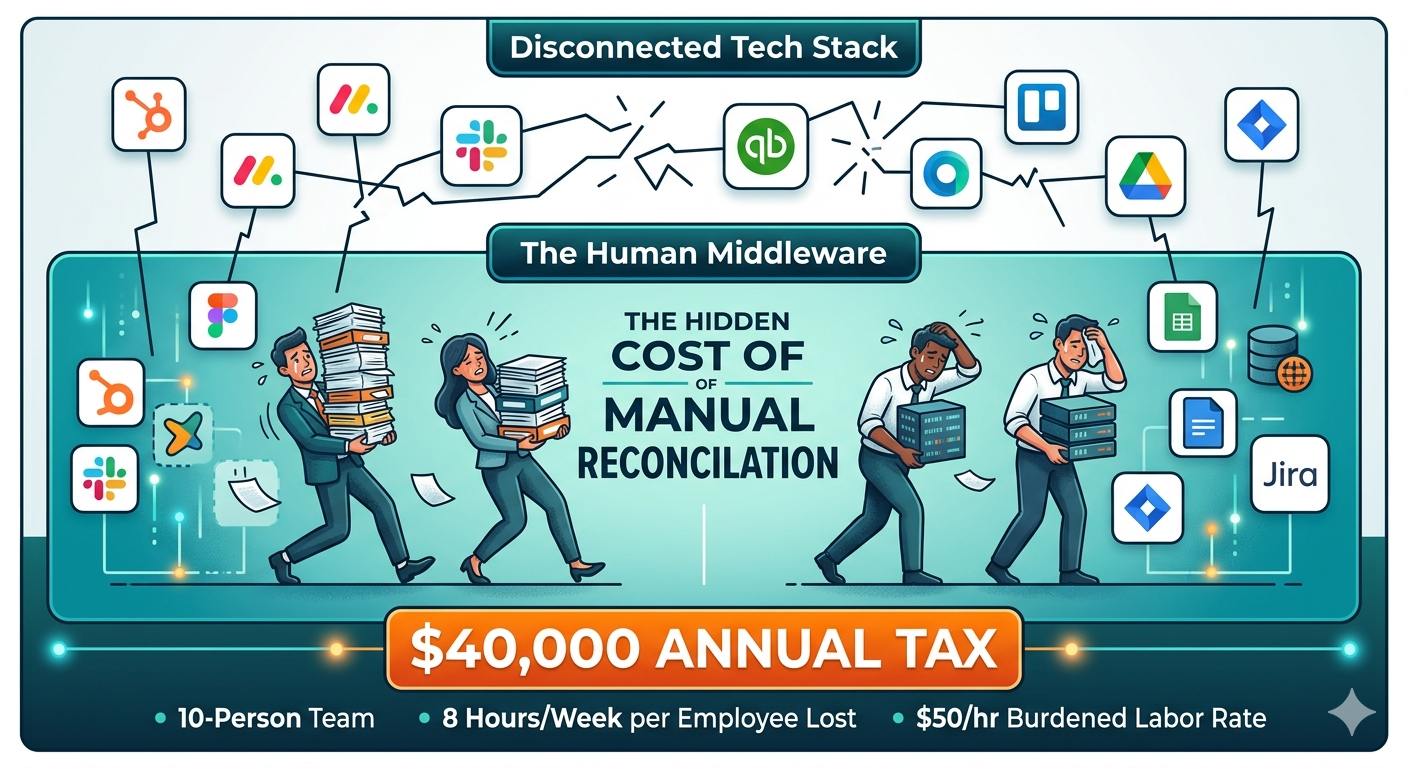
he Human Middleware Tax is the cost consulting firms pay when professional staff manually bridge the gaps between disconnected software systems. In a 10-person firm, this tax drains approximately $40,000 per year in wasted labor across three friction points: the Ghosting Gap (leads lost to slow response), the Reporting Lag (8+ days to deliver client reports), and the Recall Tax (6–15 hours per week per person searching for client context). Firms that automate these asynchronous workflows decouple revenue growth from headcount. Firms that don't hit a structural ceiling where growth in client volume never translates into profit.
Key takeaways:
-
Consulting firms between 5 and 50 employees hit a "structural ceiling" where the complexity of managing a larger team consumes the gains that scale was supposed to provide. The root cause is the Human Middleware Tax — humans acting as connective tissue between isolated data systems.
-
Three friction points drive the tax: 75% of leads evaporate without engagement within 5 minutes (Ghosting Gap), client reports take 8+ days to deliver (Reporting Lag), and staff lose 6–15 hours weekly searching for client context (Recall Tax).
-
The fix isn't better integrations — it's agentic orchestration: AI workflows that use reasoning loops to pursue goals autonomously, rather than brittle "if-then" triggers that break when data formats change.
In the global coaching and consulting market — a sector now exceeding $20 billion and growing by nearly 20% annually — a strange paradox has emerged. For agencies with between 5 and 50 employees, growth in client volume rarely translates linearly into profit margins. Instead, these firms often hit a "structural ceiling" where the complexity of managing a larger team consumes the very gains that scale was supposed to provide.
Recent analysis into AI-native infrastructure reveals the culprit: the Human Middleware Tax.
The anatomy of the Middleware Tax
The "Human Middleware Tax" is the pervasive reliance on professional staff to manually bridge the gaps between disconnected software systems like HubSpot, Monday.com, and QuickBooks. In a 10-person firm, this tax is estimated to drain approximately $40,000 per year in wasted labor.
When an agency relies on humans to act as the "connective tissue" between isolated data islands, three critical friction points emerge that kill growth:
The Ghosting Gap
Analysis shows that 75% of leads evaporate if they aren't engaged within a narrow five-minute window. Most agencies operate on a "linear response" model — a lead comes in after hours, sits in a CRM, and waits for a human to log in the next morning. By then, the strategic momentum is lost.
The Reporting Lag
The average time to deliver a polished client report is roughly 8 days, with some firms stretching to 2–3 weeks. This creates a "historical record" rather than a "strategic tool." Clients receive data about what happened last month, rather than insights on what to do tomorrow.
The Recall Tax
The third friction point — the Recall Tax — is the most expensive. -Auditing 50+ consulting firms revealed it costs between $12K and $100K annually, and it compounds with every new client and every team change. Staff members lose between 6 and 15 hours every week searching for client context. This is the cost of unstructured data — information buried in Slack threads, email chains, and call transcripts. When an account manager is absent, the agency suffers from "Knowledge Silos," often rendering them unable to respond to basic client inquiries without significant manual digging.
Moving from integration to agentic orchestration
To break through the structural ceiling, agencies must move beyond standard automation (simple "if-then" triggers) and toward Agentic Orchestration. Standard integrations are brittle; they break when data formats change or when a process requires a judgment call. In contrast, agentic workflows (specifically Level 3-4 agents) use reasoning loops to pursue goals autonomously.
Agentic orchestration isn't about replacing consultants with AI — it's about deploying AI the way Toyota deploys automation: amplifying human capability instead of substituting for it.
For example, rather than building a Zapier chain that pushes a lead from a web form to a CRM to Slack, an agentic system can assess the lead's fit, draft a personalised response, schedule a follow-up, and alert the right team member — all within minutes. The critical difference is adaptability: when the input changes, the agent reasons through the new context rather than failing silently.
By deploying "Persistent Client Memory" through agentic RAG (Retrieval-Augmented Generation), firms can eliminate the Recall Tax. When the "client brain" is accessible via a simple query, an agency can recover up to 38 hours of high-value time per week. This allows senior experts to stop acting as data janitors and return to the work that AI cannot replicate: strategic empathy and creative vision.
The long-term play is infrastructure. Every professional services firm will eventually run on a context layer— a system that captures, connects, and surfaces client knowledge automatically. The firms that build it first get a compounding advantage.
The path forward
The transition to an AI-native infrastructure isn't about replacing the human element; it's about removing the manual friction that keeps human experts from doing their best work. Firms that continue to rely on manual "middleware" will find it impossible to compete on price or delivery speed. Those that automate their asynchronous workflows will finally decouple their revenue growth from their headcount.
The Context Leak Scanner identifies which of these three friction points is costing your firm the most. No login required — see your firm's Recall Tax number in 3 minutes.
Run the free Context Leak Scanner →
The question for agency founders is no longer if they should automate, but how quickly they can stop paying the $40,000 tax on their own talent.
Frequently asked questions
Why do consulting firms scale headcount but not profit?
Consulting firms hit a "structural ceiling" because of the Human Middleware Tax — the cost of professional staff manually bridging gaps between disconnected software systems. In a 10-person firm, this drains approximately $40,000 per year. As firms grow, coordination complexity increases faster than revenue.
What is the Human Middleware Tax?
The Human Middleware Tax is the pervasive reliance on professional staff to manually connect isolated data systems. It manifests as three friction points: the Ghosting Gap (leads lost to slow response), the Reporting Lag (8+ days for client reports), and the Recall Tax (6–15 hours per week per person searching for client context).
How do consulting firms break through the profitability ceiling?
By moving from standard automation (brittle "if-then" integrations) to agentic orchestration — AI workflows that use reasoning loops to pursue goals autonomously. This includes persistent client memory that eliminates the Recall Tax by making all client context queryable in seconds