Why every consulting firm will need a knowledge management system by 2032
The shift from model quality to prompt quality means consulting firms need a context layer — a system that knows your clients. Here's why 2032 is the deadline.
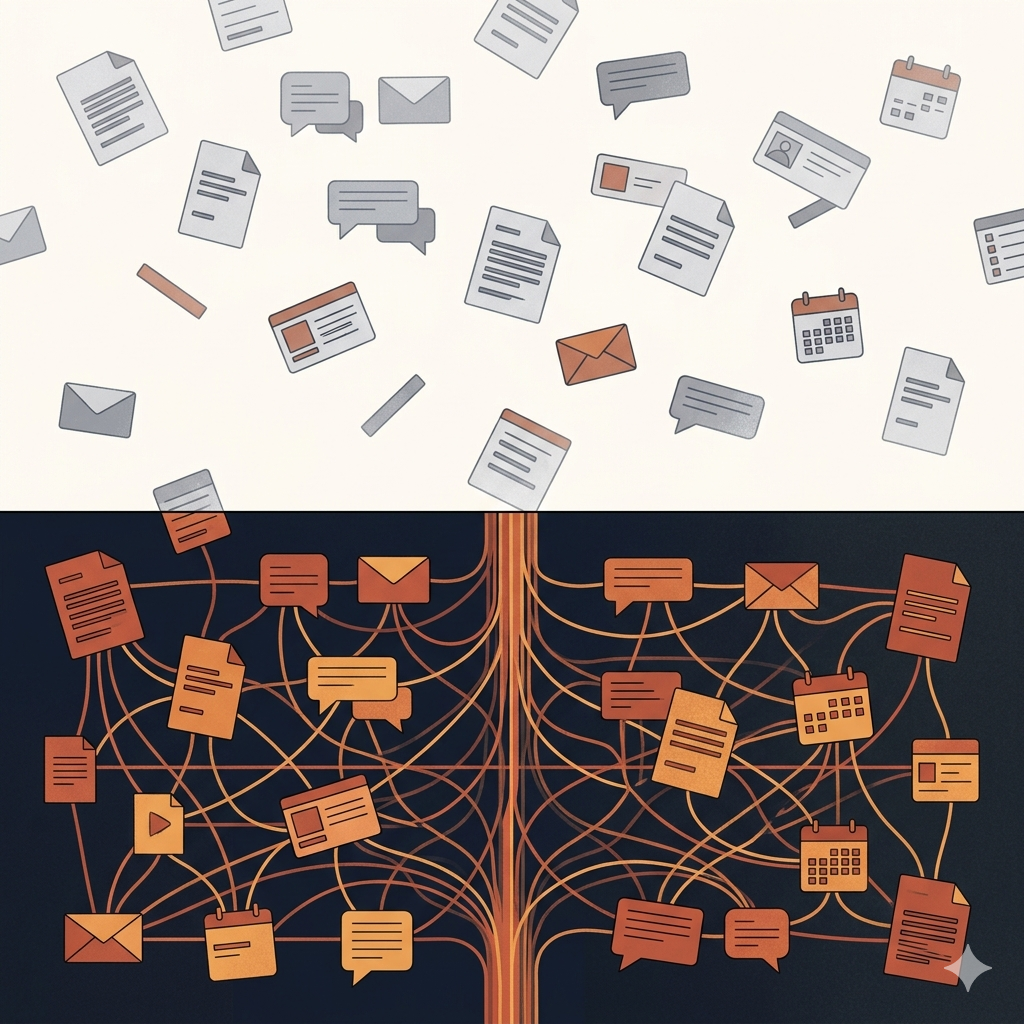
A context layer is a persistent knowledge system that captures, connects, and surfaces everything a consulting firm knows about its clients — across every tool, conversation, and handover. By 2032, the firms that win in consulting, legal, accounting, and advisory services will all have one. The firms that adopt one early will compound knowledge instead of losing it. The firms that don't will be out-operated by firms half their size.
Key takeaways:
-
The AI bottleneck has shifted from prompt quality to context quality — the firms with better client knowledge retrieval will outperform regardless of which model they use.
-
Most consulting firms run 8+ tools optimized for content creation, but none optimized for knowledge retrieval. This gap costs $12K–$100K+ per year in what's called the Recall Tax.
-
A context layer turns accumulated client knowledge into a compounding asset: faster handovers, better proposals, transferable client relationships.
That's not a tech prediction. It's a business one. And it's closer than it sounds.
What a context layer actually is
A professional services firm is, structurally, a context machine. Every client engagement is a multi-month accumulation of decisions, commitments, relationships, and problems solved. Whether you're a 12-person boutique strategy firm, a mid-size accounting practice, or a law firm with three offices — the product is knowledge. It's the working history of every engagement you've ever run.
A context layer is the architecture that turns that history into something retrievable. Emails, chat threads, documents, call transcripts, CRM notes, project tool state — all indexed, ranked by relevance, attributed to source, and queryable in plain language. Not another tool in the stack. A layer underneath the tools you already use.
Ask: "what did this client say about data architecture requirements last quarter?" — the answer surfaces, with the source, in seconds. Regardless of which tool the conversation originally lived in.
That's the layer. That's what's coming.
Why now
For most of the last two years, the valuable AI skill was prompt engineering. A sharp prompt could pull a useful answer out of an average model. Job titles appeared around it. Courses got sold.
That window is closing. The models have gotten good enough that the quality of the prompt matters less than the quality of the context you feed into it. A mediocre prompt wrapped around the right context beats a beautifully engineered prompt wrapped around nothing.
The bottleneck moved. It's no longer "how do I ask?" It's "what does the model know when I ask?"
For a professional services firm, that's a structural advantage waiting to be picked up. The context your firm has already generated — every engagement, every proposal, every call note, every commitment logged — is the moat. Anyone can use the same model. Anyone can write a similar prompt. Your accumulated client context is the one thing a competitor cannot copy.
But it's only a moat if it's retrievable. Right now, for most firms, it isn't.
What the gap looks like in practice
The average consulting, legal, or accounting firm runs 8+ tools. Each one optimised for creation. None of them optimised for retrieval. Slack, Gmail, Drive, Notion, the CRM, the project tool, the time-tracking system, the document management platform. Knowledge keeps getting generated. Less and less of it stays accessible.
Without a context layer, firms pay what we call the Recall Tax — a measurable cost that ranges from $12K to over $100K annually depending on firm size. It shows up everywhere:
A proposal that goes out at 60% because nobody could find the constraint from last month's call. A handover that takes half a day instead of twenty minutes. A commitment made twice because two consultants couldn't see each other's threads. A senior partner spending seven hours a week fielding escalations an associate could have answered — if they'd had the same retrieval surface.
Today, the typical consulting firm stores client knowledge across three or more disconnected tools, and no single person — or system — can surface the full picture in under 15 minutes.
And it's widening, because every month of operating without a context layer is another month of knowledge generated faster than it can be indexed.
The stakes
Firms that make their context retrievable start compounding. Every engagement feeds back into a searchable base the next engagement can draw from. New team members brief up in minutes. Open commitments surface before they become missed commitments. Client relationships become transferable assets — not personal ones that walk out the door when someone leaves.
Firms that don't stay stuck in the headcount-scaling model. Every new client = more people. Every departure = evaporated context. The ceiling is the top partner's calendar.
Two firms with identical capability, identical clients, identical pricing — completely different outcomes, because one has a context layer and the other doesn't.
A context layer doesn't just store knowledge — it changes how AI agents operate inside your firm. The difference is deploying AI like Toyota, not like GM: capability amplification, not human replacement.
Where Aether fits
I'm building Aether as the context layer for professional services firms. Starting with consulting — then legal, accounting, advisory. One core. Many verticals. Zero knowledge lost.
The bet is that the next six years will reward the firms that treated their accumulated context as the asset it is — and that a layer purpose-built for professional services, not a generic enterprise search tool, is what it takes to unlock it.
Most consulting firms don't know where their context leaks are. The Context Leak Scanner shows you in 3 minutes — no login required.
Run the free Context Leak Scanner
The question I'd leave you with is the same one I opened with: in six years, every professional services firm will run on a context layer. Will yours be one you built early — or one you're scrambling to catch up with?
Frequently asked questions
What is a context layer for consulting firms?
A context layer is the architecture that makes a firm's accumulated client knowledge — emails, call transcripts, documents, Slack threads, CRM notes — retrievable in seconds through plain-language queries. It sits underneath existing tools rather than replacing them, turning scattered knowledge into a searchable, compounding asset.
Why do consulting firms need better knowledge management now?
The AI bottleneck has shifted from prompt quality to context quality. Models are now good enough that the quality of the prompt matters less than the quality of the context you feed into it. Firms with better client knowledge retrieval will outperform competitors using the same AI models, because accumulated client context is the one thing a competitor cannot copy.
How much does poor knowledge retrieval cost a consulting firm?
Most consulting firms lose between $12K and $100K+ per year in what's called the Recall Tax — absorbed billable capacity spent reconstructing client knowledge that already exists somewhere in the firm. The cost scales with team size: firms of 8–15 people face the worst structural exposure because they're too large for one person to hold all context but too small to have built retrieval infrastructure.